5 Ways to Boost Your Satellite Internet Speed


Andreas Rivera
Mar 12, 2026
Icon Time To Read4 min read

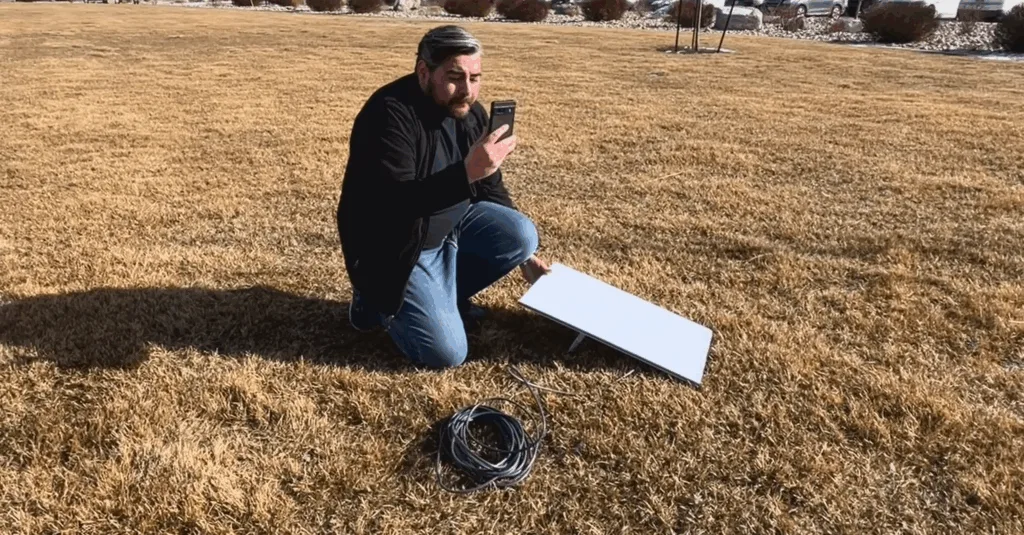
The Starlink App can help you reorient your dish when you lose your signal or have a weak connection. | Photo by Kayla Fischer for SatelliteInternet.com

In the early days of satellite internet, we were just happy to get an email through without the dial-up screech. But as we move through 2026, the stakes have changed. Whether you're trying to join a high-stakes Zoom meeting from a remote cabin in the Rockies or you're a rural gamer tired of seeing "Connection Lost" on your screen, you've likely realized that speed is only half the battle.

Satellite internet service has come a long way—Starlink is pushing 350 Mbps, and Amazon Leo is finally peeking over the horizon—but it still isn't the fastest in the world. Even with the latest Gen 3 hardware, physics is a tough opponent. If your everyday activities are lagging, it's time to troubleshoot.
1. Check for “Micro-Interruptions” (Dish Obstructions)

Satellite internet quality heavily depends on your dish having a perfect, unblinking view of the sky. If your dish isn't pointed in the optimal direction, you're not catching the best signal.

Starlink is a different story: Since it's a self-install system, you’re the technician. The 2026 Starlink app update has made the AR obstruction tool snappier than ever. When I tested the Starlink Mini recently, I found that even a single power line or a roof eave can cause “micro-interruptions.” These might not kill your Netflix stream, but they will ruin a video call. Aim for 0% obstructions for the best experience.

Hughesnet and Viasat: These providers use professional installers to align dishes with massive Geosynchronous (GEO) satellites. If you notice a sudden drop in speed after a storm, the wind might have physically nudged your dish. Don't try to realign these yourself—the tolerances are tiny. Call their support lines to have a tech come out.

2. Winterize Your Hardware (Snow and Ice)

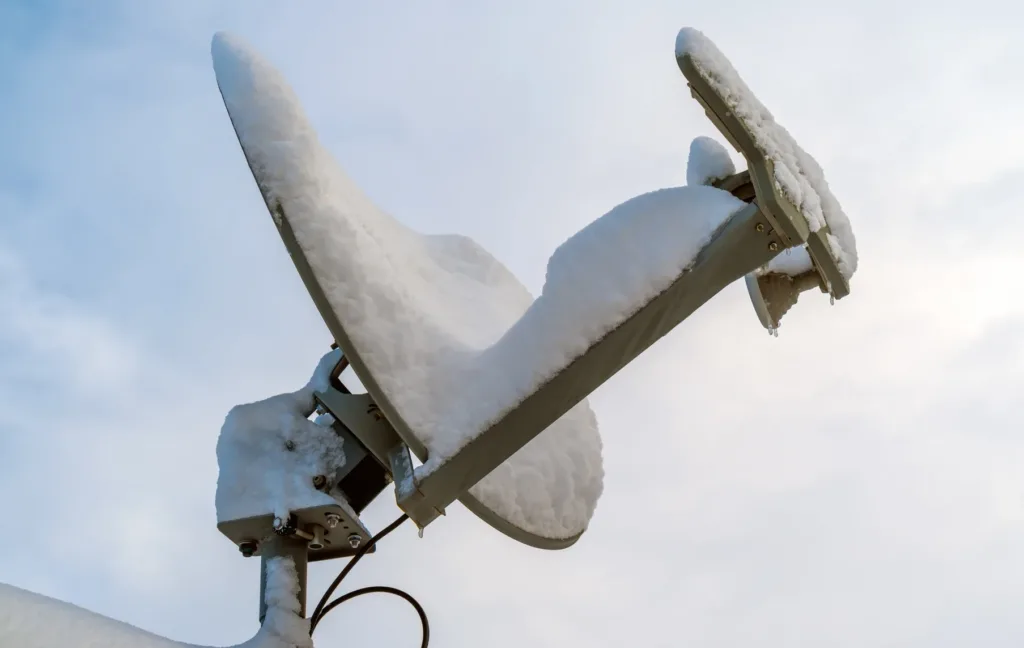
In the winter, snow is often the culprit of slow performance from your satellite dish. It's important to have a plan to keep snow buildup off your dish. | Image by iStock

For those living at high elevations and colder climates, snow and ice can be the bane of a stable connection. Snow accumulation acts like a physical barrier for radio waves. Modern Starlink dishes, including the Gen 3 and Mini, come with a built-in heating element that you can control via the app. You can set this to "Automatic" so it detects snow on its own, or "Always On" during a heavy blizzard. Just keep in mind that if you're living off-grid on a battery bank, this heating feature uses significantly more power than the dish's standard operation.

For Hughesnet and Viasat hardware, which don't have built-in heaters, you'll need to be a bit more proactive. I usually recommend a specialized heater like the HotShot, which is a simple metal element that clears snow automatically when temperatures hit freezing. If you have to clear it manually, use a soft broom and be gentle so you don't ruin the alignment. Whatever you do, stay away from the "home remedies" you see on Reddit—never spray WD-40, silicone, or PAM cooking spray on your dish. These chemicals can destroy the special weatherproof coating on the equipment, leading to permanent signal loss and an expensive replacement fee from your provider.

3. Optimize Your Home Network (Router & Wi-Fi)

Sometimes the "slow internet" isn't the satellite's fault—it's your Wi-Fi. You can use an Ethernet cable to plug your computer directly into the router. This bypasses any interference from household appliances or thick walls. If you must use Wi-Fi, ensure your device is connected to the 5 GHz band rather than the 2.4 GHz band; it’s much faster and less prone to congestion from your neighbors' networks, though you'll need to stay closer to the router for it to work effectively.

If you’re a power user, the Starlink router might feel a bit basic. In 2026, you can easily toggle "Bypass Mode" in the app to use a high-end third-party router (like an ASUS or TP-Link) for better range. Another option is to use multiple Starlink routers to create a mesh network.

4. Manage Your "Priority Data"

Most satellite plans (with the notable exception of Starlink) come with a priority data cap. Once you hit that limit, your provider throttles your speed to a crawl—usually between 1 and 3 Mbps. On a Hughesnet plan, you can monitor this through their app and buy "Data Tokens" if you're in a pinch; these tokens start at $3 for 2GB and, fortunately, never expire, rolling over until you actually use them. Viasat's "Unleashed" plans offer a much larger 850GB soft cap, but you'll still see a major slowdown if you're a heavy streamer who exceeds that limit.

All of Starlink's residential plans are unlimited, but they can deprioritize "Standard" users in congested areas. If you're consistently slow, you might need to bump up to a "Priority" plan.

5. Troubleshooting Specific Connections

When things go wrong, here is your 2026 cheat sheet:

  • Starlink: Use the app first. If it shows "Offline," check the cable connection—the Gen 3 cables can be finicky. If you need a human, Starlink now has a 24/7 hotline (1-866-606-5103) for US customers.

  • Hughesnet: Log into the System Control Center on your browser and run a "Connectivity Test." It will tell you if the issue is with the modem software or the signal. A simple 5-minute power cycle (unplug it!) fixes 90% of issues.

  • Viasat: If you see a pink or red light on your modem, you're offline. Check the "MyViasat" app for local outages. Viasat is particularly sensitive to "Rain Fade," so if it's pouring outside, you might just have to wait it out.

FAQ

Does weather like rain or clouds always slow down my satellite internet?

Not necessarily. While satellite signals are transmitted via radio waves that can be dispersed by water, light rain or standard cloud cover shouldn't tank your connection. However, heavy, dense downpours can slow your connection.

What is the difference between "Priority Data" and "Unlimited Data"?

"Unlimited" usually comes with an asterisk. Most providers, including Viasat and Hughesnet, give you a set amount of "Priority Data" each month. This is your high-speed lane. Once you use that up, you aren't cut off from the internet, but you are "deprioritized." This means your speeds are throttled to a crawl (often 1–3 Mbps) during peak hours while customers who still have priority data get the faster speeds. Starlink is the outlier here, offering mostly unthrottled data, though they may still deprioritize "Standard" users in extremely crowded areas.

Why is my Starlink app showing "Offline" even when the sky is clear?

If the weather is fine and you don't see any obvious obstructions, an "Offline" status is usually a hardware or sync issue. The most common culprit is a loose connection; the proprietary cables can sometimes look plugged in but aren't fully seated.

Will a VPN slow down my satellite connection?

Yes, a VPN will almost always add an extra layer of "latency" (lag) to a satellite connection. Because your data already has to travel to space and back, adding a VPN means it also has to travel to a distant secure server before reaching its destination.

Andreas Rivera
Written by
Andreas Rivera is a lifelong writer with a decade-spanning career in journalism and marketing. He comes to SatelliteInternet.com with several years of experience writing about business and technology. His passion for researching the latest advancements in tech, especially the now essential need for reliable internet access, fuels his goal of educating others about how these innovations affect and improve our everyday lives. When not researching and writing about SatelliteInternet.com, you’ll likely find him buried in a good book or enjoying the great outdoors with a fishing rod.